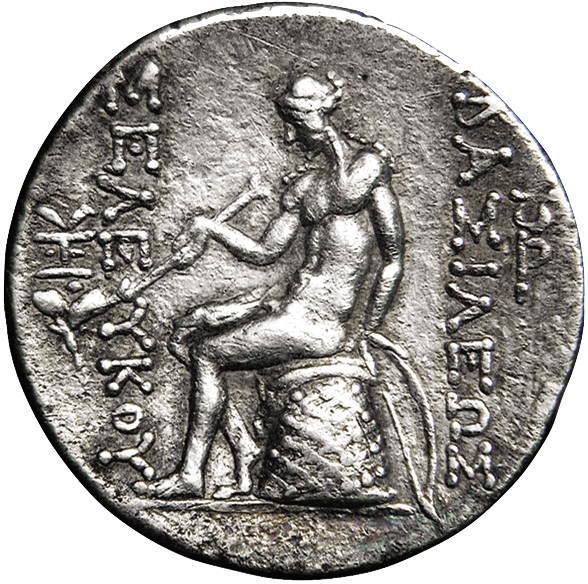
A surname of Apollo,
which he received for his having conquered the serpent
Python, or because he was worshipped at Delphi;
;alled also Pytho.
which he received for his having conquered the serpent
Python, or because he was worshipped at Delphi;
;alled also Pytho.
Charles - 1867 - Classical Dictionary
And it may seem not en-
tirely improbable that he might wish to be farther ac-
quainted with the Phoenician philosophy, of which he
had doubtless heard a general report from his father,
whe was probably of Phoenician origin. But it is cer-
tainly a fiction of tho Alexandrean school that Pythag-
oras received his doctrines of numbers from the Phoe-
nicians, for their knowledge of numbers extended no
farther than to the practical science of arithmetic. In
Egypt, Pythagoras was introduced, by the recommend-
ation of Polycrates, tyrant of Samos, to Amasis, king
of Egypt, a great patron of learned men, particularly
those of Greece, that he might the more easily obtain
access to the colleges of the priests. The king him-
? ? self could scarcely, with all his authority, prevail upon
Generated for (University of Chicago) on 2014-12-26 09:16 GMT / http://hdl. handle. net/2027/uva. x001045523 Public Domain, Google-digitized / http://www. hathitrust. org/access_use#pd-google
? PYTHAGORAS.
PYTHAGORAS.
91 the PMiasians. Here be first assumed the appella-
tion of philosopher. Cicero ascribes the invention of
this term to Pythagoras. If this be correct, Pythago-
ras probably did not intend, as has been commonly
imagined, to deprecate the reputation for wisdom, but
to profess himself devoted to the pursuit of it. The
well-known story, which explains the origin of the
name, suggests an entirely false notion of his view of
life, so far as it implies that he regarded contetnplation
as the highest end of human existence. The story is
as follows: It seems that Leon, charmed with the in-
genuity and eloquence with which he discoursed on
various topics, asked him in what art he principally
excelled, to which Pythagoras replied, that he did not
profess himself master of any art, but that he was a
philosopher. Leon, struck with the novelty of the
term, asked Pythagoras who were philosophers, and
wherein they differed from other men. Pythagoras
replied that, as in the public games, while some are
contending for glory, and others are buying and selling
in pursuit of gain, there is always a third class, who at-
tend merely as spectators; so in human life, amid the
various characters of men, there is a select number
who, despising all other pursuits, assiduously apply
themselves to the study of nature and the search after
wisdom; these, added Pythagoras, are the persons
whom I denominate philosophers. -- Pythagoras is
generally believed to have found Polycrates ruling
at Samoa, on his return from his travels, and his aver-
sion to the tyrant's government was sometimes as-
signed as the motive which led him finally to quit his
native island. If there were any foundation for this
story, it must probably be sought, not in any personal
enmity between him and Polycrates--who is said to
have furnished him with letters of recommendation to
Amasis--but in his conviction that the power of Po-
lycrates would oppose insuperable objections to his de-
signs. For it seems certain that, belore he aet out for
the West, he had already conceived the idea to which
he dedicated the remainder of his life, and only sought
for a fit place and a favourable opportunity for carry-
ing it into effect. We, however, find intimations, that
he did not leave Samoa until he had acquired some
celebrity among the Asiatic Greeks, by the introduc-
tion of certain mystic rites, which Herodotus repre-
sents as closely allied to the Egyptian, and to those
which were celebrated in Greece under the name of
Orpheue as their reputed founder. But as we cannot
believe that the establishment of a new form of reli-
gion was au object that Pythagoraa ever proposed to
himself apart from his political views, wo could only
regard these mysteries, supposing the fact ascertained,
in the light of an eaaay or an experiment, by which he
sounded the disposition or the capability of his coun-
trymen for the reception of other more practical doc-
trines. The fame of his travels, his wisdom, and
sanctity had probably gone before him into Greece,
where he appears to have stayed some time, partly, per-
haps, to enlarge his knowledge, and partly to heighten
his reputation. It was no doubt for the former pur-
pose that he visited Crete and Sparta, where he found
a model of government and discipline more congenial
to his habits of thinking than he could have met with
anywhere else but in Egypt or India. If, as is highly
probable, he stopped on the same journey at Oly mpia and
at Delphi, it was, perhaps, less from either curiosity or
devotion, than from the desire of obtaining the sanction
? ? of the oracles, and of forming a useful connexion with
Generated for (University of Chicago) on 2014-12-26 09:17 GMT / http://hdl. handle. net/2027/uva. x001045523 Public Domain, Google-digitized / http://www. hathitrust. org/access_use#pd-google
? PYTHAGORAS.
PYTHAGORAS.
ei It was wOmposed of young men carefully select-
ed from the noblest families, not only of Crotona, but
oi other Italiot cities. Their number amounted, or
was confined, to three hundred; and if he expected
by their co-operation to exercise a sway firmer and
more lasting than that of a lawgiver or a magis-
trate, first over Crotona, and, in the end, over all the
Italiot cities, bis project, though new and bold, ought
not to be pronounced visionary or extravagant. This
celebrated society, then, was at once a philosophical
scho. ji, a religious brotherhood, and a political associa-
tion; and all these characters appear to have been in-
separably united in the founder's mind. The ambition
of Pythagoras was, assuredly, truly lofty and noble.
He aimed at establishing a dominion which he be-
lieved to be that of wisdom and virtue, a rational su-
premacy of minds, enlightened by philosophy and pu-
rified by religion, and of characters fitted to maintain
an ascendant over others by habits of self-command.
At first Pythagoras obtained unbounded influence over
all classes at Crotona, and effected a general reforma-
tion in the habits of the people; while in other Italian
cities he gained such a footing as enabled him cither
to counteract revolutionary movements, or to restore
aristocratical government where it had given way to
tyranny or democracy. --After the celebrated battle in
which the people of Crotona defeated the Sybarites,
and after which they destroyed the city of the latter,
the senate of Crotona and the Pythagorean associates
seem to have been so elated by this success as to
have fancied that it was the triumph of their cause,
and that they alone were to reap its fruits. When the
question arose as to the distribution of the spoil and
of the conquered land, they insisted on retaining the
whole in the name of the state, and refused to con-
cede any share to those who had earned it all by their
toil and blood. The commonalty were, of course, ir-
ritated by the attempt. Their fury was directed
against the society, chiefly, it is said, by Cylon, a no-
ble and wealthy man, who is believed to have been
rejected by Pythagoras when he sought to be admit-
ted among his followers. A turn-out took place, in
which the populace set fire to Milo's house, where the
Pythagoreans were assembled. Many perished, and
the rest only found safety in exile. It is not clear
whither Pythagoras himself was at Crotona during
ibis commotion; the general belief seems to have
been that he died, not long after, at Mctapontum. The
rising at Crotona appears to have been followed by
snnil. li scenes in several other Italian cities, as at
Caulonia, Locri, and Tarcnium, which would prove
the extensive ramifications of the order, and that it
everywhere disclosed the same political character.
Many of the fugitives toon refuge in Greece, but con-
fusion and bloodshed continued to prevail for many
years in the cities which had been the seats of the so-
ciety. Tranquillity was at length restored by the me-
diation of the Acha. -ans of the mother country, and
sixty of the exiles returned to their homes. But their
presence seems to have given rise to fresh troubles,
perhaps through their opposition to the demccratical
institutions which Crotona and other cities adopted
from Achaia: and a* a later period we find some cel-
ebrated Pythagorean* in Greece, who had been driven
out of Italy by their political adversaries, while oth-
ers remained there, and endeavoured, with partial suc-
cess, to revive the ancient influence of the order.
? ? [Tiir'. -MiU't Greece, vol. 2, p. 145, segq. --Hiucr's
Generated for (University of Chicago) on 2014-12-26 09:17 GMT / http://hdl. handle. net/2027/uva. x001045523 Public Domain, Google-digitized / http://www. hathitrust. org/access_use#pd-google
? PYTHAGORAS.
PYTHAGORAS.
. ijclmed to indulge, with what kind of company he
chose to associate, how he passed his leisure moments,
and what incidents appeared to excite in him the
strongest emotions of joy and sorrow. From these
and other circumstances, Pythagoras formed an accu-
rate judgment of the qualifications of the candidate;
ind he admitted no one into his society till he was ful-
ly persuaded of his capacity of becoming a true philos-
opher. Upon the first probationary admission, the
fortitude and self-command of the candidate was put
to the trial by a long course of severe abstinence and
rigorous exercise. The injunction of silence has al-
ready been alluded to. This silence, or ixtuvOia, as
it was termed, is not to be confounded with that sa-
cred reserve with which all the disciples of Pythagoras
were bound, upon oath, to receive the doctrines of
their master, that they might, from no inducement
whatsoever, suffer them to pass beyond the limits of
their sect. Pythagoras, like all other philosophers,
had his exoteric, or public, and his esoteric, or private,
doctrines. The restraint which he put upon the words
of his pupils, by enjoining silence for so long a time,
was certainly, in one point of view, a very judicious
expedient, as it restrained impertinent curiosity, and
prevented every inconvenience of contradiction. Ac-
cordingly, we find that his disciples silenced all doubts,
and refuted all objections, by appealing to his author-
ity, kirbc i$a, ipse dixit (" he himself," i. e. , the
master, " said so"), decided every dispute. Nor was
this preparatory discipline deemed sufficiently severe
without adding, during the years of initiation, an en-
tire prohibition of seeing their master, or hearing his
lectures except from behind a curtain. And even this
privilege was too great to be commonly allowed; for
in this stage of tuition they were usually instructed
by some inferior preceptor, who barely recited the doc-
trine of Pythagoras, without assigning the reasonings or
demonstrations on which they were founded, and re-
quired the obedient pupil to receive them as unques-
tionable truths upon their master's word. Those who
had sufficient perseverance to pass these several steps
of probation were at last admitted among the Esoter-
ics, ar. d allowed to see and hear Pythagoras behind the
curtain. But if it happened that any one, through im-
Datience of such rigid discipline, chose to withdraw
from the society before the expiration of the term of
trial, he was dismissed with a share of the common
stock, the double of that which he had advanced; a
tomb was erected for him as for a dead man; and he
was to be, as such, forgotten by the brethren as if he
had been actually dead. It was the peculiar privi-
lege of the Esoterics to receive a full explanation
of the whole doctrine of Pythagoras, which to others
was delivered in brief precepts and dogmas under
tho concealment of symbols. They were also per-
mitted to take minutes of their master's lectures in
writing, and to propose questions and offer remarks
upon every subject of discourse. These disciples
were particularly distinguished by the appellation of
the Pythagoreans; they were also called the Math-
ematicians, from the studies upon which they enter-
ed immediately after their initiation. After they had
made a sufficient progress in geometrical science,
they were conducted to the study of nature, the in-
vestigation of primary principles, and the knowledge
of God. Those who pursued these sublime specula-
tions were called Theorists; and such as more par-
? ? ticularly devoted themselves to theology were styled
Generated for (University of Chicago) on 2014-12-26 09:17 GMT / http://hdl. handle. net/2027/uva. x001045523 Public Domain, Google-digitized / http://www. hathitrust. org/access_use#pd-google
? PYTHAGORAS.
PYTHAGORAS.
r. was fcrtfier corrupted by the followers of Plato, e\-en
in the Old Academy, and afterward in the Alexan-
drean school. The latter, especially, made no scruple
of obtruding their own dogmas upon the world, under
the sanction of Pythagoras or any other ancient sage,
and were chiefly employed in attempting to reconcile,
or, rather, confound the doctrines of the ancient phi-
losophers with later systems. --If the unconnected and
doubtful records which remain can enable us to form
any judgment upon this subject, the following may
perhaps be considered as a faint delineation of the Py-
thagorean philosophy: The end of philosophy is to
free the mind from those encumbrances which hinder
its progress towards perfection, and to raise it to the
contemplation of immutable truth, and the knowledge
of divine and spiritual objects. This effect must be
produced by easy steps, lest the mind, hitherto con-
versant only with sensible things, should revolt at the
change. The first step towards wisdom is the study
of mathematics, a science which contemplates objects
that lie in the middle way, being corporeal and incor-
poreal beings, and, as it were, on the confines of both,
and which most advantagcoualy inures the mind to
contemplation. --The most probable explanation of the
Pythagorean doctrine of numbers is, that they are
used as symbolical or emblematical representations of
the first principles and forms of nature, and partic-
ularly of those eternal and immutable essences to
which Plato afterward gave the appellation of Ideas.
Not being able, or not choosing, to explain in sim-
ple language the abstract notions of principles and
forms, Pythagoras seems to have made use of num-
bers, as geometricians make use of diagrams, to as-
sist the conceptions of scholars. More particularly,
conceiving some analogy between numbers and the
intelligent forms which subsist in the Divine Mind,
he made the former a symbol of the latter. As num-
bers proceed from unity, or the Monad, as a simple
roo' whence they branch out into various combina-
tions, and assume new properties in their progress, so
ho conceived the different forms of nature to recede,
at different distances, from their common source, the
pure and simple essence of Deity, and at every de-
gree of distance to assume certain properties in some
measure analogous to those of numbers; and hence he
concluded that the origin of things, their emanation
from the first being, and their subsequent progression
through various orders, if not capable of a perfectly
clear explanation, might, however, be illustrated by
symbols and resemblances borrowed from numbers.
According to some writers, the Pythagorean Monad
denotes the active principle in nature, or God; the
Duad, the passive principle, or matter; the Triad, the
w;rld formed by the union of the two former; and
the Tetractys, the perfection of nature. The Tetrac-
tys, or quadrate, according to the Pythagoreans, was
the root of the eternally flowing nature. (Carm. ,
Aur. , 47. --Iamblich. , Vtt. Pythag, 162. ) What they
vxidcistocl by the grand Tetractys, whether the sum
of the fiist four numbers, that is, ten; or the sum of
Jie first four odd and the first four even, that is, thir-
jr-six, is unimportant; for the essential is not the
winbol, but what the svmbol represented. (Plut. , de
U et On. , 76. --Id. , ill Amm. Prccr. , 30. -- Hitter,
Hi; of Philot. , vol. I, p. 363. ) Next to numbers,
Busic had the chief place in the preparatory exercise
A the Pythagorean school, by means of which the
? ? mind was to be raised above the domimin of passion,
Generated for (University of Chicago) on 2014-12-26 09:17 GMT / http://hdl. handle. net/2027/uva. x001045523 Public Domain, Google-digitized / http://www. hathitrust. org/access_use#pd-google
? PYTHAGORAS.
PYT
Hercules from the length of the Olympic course,
which measured six hundred of his feet. Observing
! . uw much shorter a course six hundred times the
length of an ordinary sized man was than the Olympic
course, he inferred, by the law of proportion, the length
of Hercules' foot; whence the usual proportion of the
length si the foot to the height of a man enabled him
to determine the problem. --On Astronomy, the doc-
trine of Pythagoras, or, at least, of the ancient Pyth-
agoreans, was as follows: The term Heaven either
denotes the sphere of the fixed stars, or the whole
space between the fixed stars and the moon, or the
whole world, including both the celestial sphere and
I'M earth. There are ten celestial spheres, nine of
which are visible to us; namely, that of the fixed stars,
those of the seven planets, and those of the earth.
The tenth is the Antichthon, or an invisible sphere
opposite to the earth, which is necessary to complete
the harmony of nature, as the Decad is the completion
of the numerical harmony. Fire holds the middle
place in the universe; or in the midst of the four el-
ements is placed the fiery globe of unity; the earth is
not without motion, nor situated in the centre of the
ipheres, but is one of those planets which make their
/evolutions about the sphere of fire. The distance of
the several celestial spheres from the earth corresponds
to the proportion of notes in a musical scale. The
moon and other planetary globes are habitable. The
earth is a globe, which admits of Antipodes. From
several of these particulars respecting the astronomical
doctrine of Pythagoras, it has been inferred that he
vas possessed of the true idea of the solar system,
which was revived by Copernicus, and fully established
by Newton. With respect to God, Pythagoras ap-
pears to have taught, that he is the universal mind,
diffused through all things, the source of all animal
life, the proper and intrinsic cause of all motion, in
substance similar to light, in nature like truth, the first
principle of the universe, incapable of pain, invisible,
incorruptible, and only to be comprehended by the
. nind. Cicero also remarks, that Pythagoras conceived
God to be a soul pervading all nature, of which every
human soul is a portion, which is nothing more than
the modern system of Pantheism. The doctrine of
the Pythagoreans respecting the nature of brute ani-
ir. als, and jterf/iijti'xuQif, the Transmigration of SouU,
was the foundation of their abstinence from animal
food, and of the exclusion of animal sacrifices from
their religious ceremonies. This doctrine Pythagoras
probably learned in Egypt, where it was commonly
taught. Nor is there any sufficient reason for under-
standing it, as some have done, symbolically. --We
will end this article with a few specimens of his Sym-
bols, which, though they were at first made use of for
the purpose of concealment, and though their meaning
has always been religiously kept secret by the Pytha-
goreans themselves, have awakened much curiosity,
and given occasion to many ingenious conjectures,
which, however, unless they were more satisfactory,
it would answer no purpose to repeat. Among the
Symbols of Pythagoras, recited by lamblichus and
others, are the following; Adore the sound of the
whispering wind. Stir not the fire with a sword.
Turn aside from an edged tool. Pass not over a bal-
ance. Setting out on a journey, turn not back, for the
Furies will return wiih you. Breed nothing that has
crooked talons. Rer. eive not a swallow into your
? ? Souse. Look in-; in a mirror by the light of a candle.
Generated for (University of Chicago) on 2014-12-26 09:17 GMT / http://hdl. handle. net/2027/uva. x001045523 Public Domain, Google-digitized / http://www. hathitrust. org/access_use#pd-google
? QUA
g ur
Delphi, and Oraculum. )--II. Games celebrated in
honour of Apollo at Delphi. They were first institu-
ted, according to the fabulous opinion, by Apollo him-
self, in commemoration of the victory which he had
obtained over the serpent Python, from which they
received their name; but their origin seems, in fact, to
have been a Pancgyris (Havf/yvpic), or Festal Com-
munion, in connexion with the Delphic oracle. With
this the Dclphians combined games for the purposes
of amusement, which originally consisted of a contest
between singers in praise of the Delphian god. This
assembly was, in its more important capacity, denom-
inated the Amphictyonic council, and was charged
with the superintendence of the games. ( Wachsmuth,
Gr. Ant. , vol. 1, p. 163, Eng. transl. )--The Pythian
games were, at their first institution, only celebrated
once in nine years, but afterward every fifth year.
The crown was of bay. --For an account of the exer-
cises in the public games of the Greeks, consult the
article Olympia. (PoUer, Gr^Ani. , 2, 23. )
PvtmTus, I. a Syracusan, who defrauded Canius, a
Roman knight, to whom be had sold his gardens, etc.
\Cic, it Off. , 3, 14. )--II.
A surname of Apollo,
which he received for his having conquered the serpent
Python, or because he was worshipped at Delphi;
;alled also Pytho. (Vid. Pytho. )
Pytho, the ancient name of the town of Delphi,
which it was said to have received utto tov -vlhcOai,
because the serpent which Apollo killed rolled there.
A better derivation, however, is from nvBioBai, "to
inquire," with reference to the oracle that was consult-
ed here. The difference of quantity (IKOcJ, rri8io0ai)
does not appear to form a material objection, although
Passow thinks otherwise. (Gr. D. Handwbrt. , s. v.
Ilvdu. ) ?
Python, a celebrated serpent sprung from the mud
and stagnated waters which remained on the surface of
the earth after the deluge of Deucalion. This monster
abode in the vicinity of Delphi, and destroyed the
people and cattle of the surrounding country. Apollo,
on coming to Delphi, slew the serpent with his arrows;
and as it lay expiring, the exulting victor cried, "Now
rot (iroBev) there on the man-feeding earth;" and
hence, says the legend, the place and oracle received
the appellation of Pytho. (Vid. Pytho. ) The Pythi-
an games were fabled to have been established in
commemoration of this victory. (Vid. Pythia. )--
Dodwell supposes that the true explanation of the al-
legorical fiction relating to Apollo and Python is, that
the serpent was the river Cephissus, which, after the
deluge of Deucalion had overflowed the plains, sur-
rounded Parnassus with its serpentine involutions, and
was reduced by the rays of the sun within its due lim-
its. (DodiecWs Tour, vol. 1, p. 180. ) It is more
probable, however, that the fable was one of Oriental
origin, and was carried from that quarter of the world
tc Greece. (Vid. remarks under the article Apollo. )
Qr/ADi, a German nation on the southeastern bor-
ders of the country, in what is now Moravia. They
were connected with the Marcomanni, and, along with
them, waged war against the Romans. The Emperor
Maccus Antoninus proceeded against them in person
and repressed their inroads, but they soon after re-
newed hostilities with increased vigour. Their name
disappears from history about the fifth century. Their
territory was bounded on the south by the Danube, on
the east by the river Gran and the Jazyges, on the north
? ? by the Carpates and Sudetes, and on the west by the
Generated for (University of Chicago) on 2014-12-26 09:17 GMT / http://hdl. handle. net/2027/uva. x001045523 Public Domain, Google-digitized / http://www. hathitrust. org/access_use#pd-google
? QUI
^LINTUS.
ma he writes with an elegance which would entitle
him to a rank by the side of the purest models of the
Augustine age, if certain obscure expressions and
some specimens of affected phraseology did not betray
the writer of a later age. His tenth book, where he
? peaks of the Greek and Roman authors of the high-
er class, is one of the most instructive, and of great
importance in relation to the history of ancient litera-
ture. Time has preserved for us only two manu-
script! ef the Institutes of Quintilian. One, which
is complete, was found, at the period of the council
of Constance, in a tower of the Abbey of St. Gall,
by the celebrated Poggio of Florence; he made a
copy of this, which is now in England. Nearly at the
same time Leonard Aretin discovered a second man-
uscript in Italy, but very defective. From these two
original ones arc derived all the other manuscripts of
Quintilian. It is not known what has become of the
manuscript of St. Gall. --With regard to the dialogue
De Claris Oraloribus, commonly ascribed to Quintil-
ian, some remarks will be offered under the article
Tacitus. --The best editions of Quintilian arc, that of
Burmann, Lugd. Bat. , 1720, 3 vols. 4to; that of Oap-
peronier, Parts, 1725, fol. ; that of Gesner, Colling. ,
1766, 4to; and particularly that of Spalding, Lips. ,
1798-1834, 6 vols. 8vo, the fifth volume of which
contains supplementary annotations by Zumpt, and
the sixth a Lexicon and Indexes by Bonelli. The
edition of Quintilian forming part of Leinaire's collec-
tion is a reprint, for the irrost part, of Spalding's.
(Schbll, Hist. Lit. Rom. , vol. 2, p. 398, seqq. --Bahr,
Gesch. Rom. Lit, p. 401, seqq. -- Fultrmann, Rom.
Lit. , vol. 2, p. 168, seqq. )
Quintus Curtius Kurt's, a Latin historical writer,
with regard to whose era great uncertainty prevails.
No ancient writer makes mention of him; the first
who speak of him are John of Salisbury and Pierre
Je Blois, who lived in the 12th century. Curtius
himself furnishes no information respecting his own
condition and origin, if we except one passage in
which he speaks of an event which happened in his
times (10, 9). He mentions this event, however, in
such obscure terms, that the commentators are all at
varianco respecting the period when he flourished.
Some, as, for example, Pithou and Bongars, place him
in the Augustan age. Others, as Ausonius Popma
and Perizonius, under Tiberius. Others, as Justus
I. ipsius and Brisson, under Claudius. Others, as
Freinsheim, Rutgers, Vossius, and many other edi-
tors, under Vespasian. Some, following the example
of Pontanus, make him to have flourished under Tra-
jan. Count Bagnolo (Delia genie Curzia e dell' eta
di Q. Curzio. &. c, Bologna, 1741, 8vo), and one of
the latest editors of Curtius, Cunze, whose edition
appeared at Hclinstadt in 1795, 8vo, have adduced
<<ome specious arguments for fixing the period of this
writer under Constantine the Great. Finally, Bnrth
brings him down as low as the first Theodosius. --Tho
history of Quintus Curtius is entitled De rebus geslis'
Alexandri Magni (" Of the exploits of Alexander the
Great"). It was divided originally into ten books, but
the first two, the end of the fifth, and the beginning
of the sixth are lost. Freinsheim has written a sup-
plement to the work, so as to complete what is thus
defective, and has succeeded in bringing together a
learned collection of facts from the different historiana
who have made mention of the operations of Alexan-
? ? der. --The work of Quintus Curtius is rather to be
Generated for (University of Chicago) on 2014-12-26 09:17 GMT / http://hdl. handle. net/2027/uva. x001045523 Public Domain, Google-digitized / http://www. hathitrust. org/access_use#pd-google
? RAB
RAT
the king cf Bavaria at Munich It is on the twelve
labours of Hercules. --The best editions of Quintus
Calaber are, that of Rhodomanmis. Hanoi. , 1604, Svo;
that of De Pauw, Lugd. Bat. , 1784, 8vo; and that of
Tychsen, Argent. , 1807, 8vo. The last, however, has
never been completed. (Scholl, Hist. Lit. Gr. , vol.
6. p 91, seqq. )
Quikinalis, a hil! at Rome, added to the city by
Servius Tulliu9. (Liv. , 1. 44. ) Numa, indeed, had
a house upon this mountain, but it was not considered
a part of the city until enclosed within the Tullian
wall. The temple of Romulus Quirinus, from which
it derived its name, was built by Numa, but afterward
reconstructed with greater magnificence by Papirius
Cursor, the dictator. (Lxv. , 10, 46. ) Some vestiges
of this edifice are said to exist in the gardens of the
Jesuits, close to the church of S. Andrea, a Monte
Catallo. The expression Monte Catallo is a corrup-
tion from Manx Cabalhit, a name applied to the Quiri-
nal at a later day from two marble horses placed there.
The Quirinal is the only one of the Seven Hills at the
present day that is populous. It is covered with noble
palaces, churches, streets, and fountains. (Rome in
the Nineteenth Century, vol. 1, p. 206, Am. ed. )
Quirinus, I. a surname of Mars among the Romans.
This name was also given to Romulus after his trans-
lation to the skies. (Ovid, Fast. , 2, 475. )--II. A sui
name of the god Janus. (Vid. remarks under the ar-
ticle Janus. )
Quirjtks, (Vid. remarks under the article Roma,
page 1172, col. 2 )
R.
Rabirius, I. C a Roman knight contemporary with
Julius Cesar. The latter had, on one or two occa-
sions, expressed with some ostentation his attachment
to the party of Marius, and he now attempted to vindi-
cate the memory of L. Saturninus, who, having been for
a long time the associate of Marius, was afterward op-
posed by him as the reluctant instrument of the senate,
and, having been taken by him in actual rebellion, had
been murdered by the armed citizens, who broke into
his place of confinement. Caesar, it is said (Sveton. ,
Vit. Jul. , 12), instigated Labienus, at this time one
of the tribunes, and afterward distinguished as one of
Caesar's lieutenants in Gaul, to accuse Rabirius, then
advanced in years, as the perpetrator of this murder.
The cause was first tried before L. Cesar and C. Cae-
sar (Dio Cass , 37, 42), who were appointed by lot to
act is special commissioners in this case, by virtue of
the yrotor's order; and the accused was arraigned
according to the old law of murder, by which, if he had
been found guilty, he would have been condemned to
be hanged. But this mode of proceeding was stopped
by Rabirius appealing to the people, or by the inter-
ference of Cicero as consul, as his speech seems to
imply (pro Rah. , c. 4, seq), and his procuring the re-
moval of the cause before another tribunal. The peo-
ple, however, it is said, were likely to condemn the
accused, when Q Metelellus Celer, one of the prae-
tors, obliged the meeting to break up, by tearing down
. the ensign which was always flying on the Janieulum
while the people were assembled, and without which,
according to ancient custom, they could not lawfully
continue their deliberations. In this manner Rabirius
? scaped; for Labienus or his instigators did not think
proper to bring forward the business again; whether
despairing of again finding the people equally disposed
? ? to condemn the accused, or whether the progress of the
Generated for (University of Chicago) on 2014-12-26 09:17 GMT / http://hdl. handle. net/2027/uva. x001045523 Public Domain, Google-digitized / http://www. hathitrust. org/access_use#pd-google
? RAVENNA.
REG
Minn mere to b i . 'rained and exercised. The vine
grew in the marshes with the greatest luxuriance, but
perished in the course of four or fiy. i years. (Strabo,
818. --Plin. , 14, 2. ) Water was scarce at thia place,
and hence Martial observes that he would rather have
a cistern of water at Ravenna than a vineyard, aince
be could sell the water for a much higher price than
to* wine. (Ep. , 3, 56. ) The same writer sportively
ai. ade* to his having been imposed upon by a tavern-
kjepei at Ravenna :ton hia calling for a glass of wa-
ter, he received one of wine! --We are not informed
it what period Ravenna receive I a Roman colony
(Strai. , 217); but it is not improbable, from a passage
in Cicero (Oral, pro Balb. , 22). that this event took
place under the consulship of Cn. I'ompeius Strabo.
Ravenna became the great naval station of the Ro-
mans on the Adriatic, in the latter times of the re-
public, a measure which seems to have originated
with Pompey the Great. It waa from Ravenna that
Cesar held a parley with the senate, when on the
point of invading Italy. (Bell. Civ. , 1, 6. ) It was
from this city, also, that ho set forward on that march
which brought him to the Rubicon, and involved his
country and the world in civil war. (Appian, Bell.
Civ. , 2, II. )--It is well observed by Gibbon (Mite.
Work; vol.
tirely improbable that he might wish to be farther ac-
quainted with the Phoenician philosophy, of which he
had doubtless heard a general report from his father,
whe was probably of Phoenician origin. But it is cer-
tainly a fiction of tho Alexandrean school that Pythag-
oras received his doctrines of numbers from the Phoe-
nicians, for their knowledge of numbers extended no
farther than to the practical science of arithmetic. In
Egypt, Pythagoras was introduced, by the recommend-
ation of Polycrates, tyrant of Samos, to Amasis, king
of Egypt, a great patron of learned men, particularly
those of Greece, that he might the more easily obtain
access to the colleges of the priests. The king him-
? ? self could scarcely, with all his authority, prevail upon
Generated for (University of Chicago) on 2014-12-26 09:16 GMT / http://hdl. handle. net/2027/uva. x001045523 Public Domain, Google-digitized / http://www. hathitrust. org/access_use#pd-google
? PYTHAGORAS.
PYTHAGORAS.
91 the PMiasians. Here be first assumed the appella-
tion of philosopher. Cicero ascribes the invention of
this term to Pythagoras. If this be correct, Pythago-
ras probably did not intend, as has been commonly
imagined, to deprecate the reputation for wisdom, but
to profess himself devoted to the pursuit of it. The
well-known story, which explains the origin of the
name, suggests an entirely false notion of his view of
life, so far as it implies that he regarded contetnplation
as the highest end of human existence. The story is
as follows: It seems that Leon, charmed with the in-
genuity and eloquence with which he discoursed on
various topics, asked him in what art he principally
excelled, to which Pythagoras replied, that he did not
profess himself master of any art, but that he was a
philosopher. Leon, struck with the novelty of the
term, asked Pythagoras who were philosophers, and
wherein they differed from other men. Pythagoras
replied that, as in the public games, while some are
contending for glory, and others are buying and selling
in pursuit of gain, there is always a third class, who at-
tend merely as spectators; so in human life, amid the
various characters of men, there is a select number
who, despising all other pursuits, assiduously apply
themselves to the study of nature and the search after
wisdom; these, added Pythagoras, are the persons
whom I denominate philosophers. -- Pythagoras is
generally believed to have found Polycrates ruling
at Samoa, on his return from his travels, and his aver-
sion to the tyrant's government was sometimes as-
signed as the motive which led him finally to quit his
native island. If there were any foundation for this
story, it must probably be sought, not in any personal
enmity between him and Polycrates--who is said to
have furnished him with letters of recommendation to
Amasis--but in his conviction that the power of Po-
lycrates would oppose insuperable objections to his de-
signs. For it seems certain that, belore he aet out for
the West, he had already conceived the idea to which
he dedicated the remainder of his life, and only sought
for a fit place and a favourable opportunity for carry-
ing it into effect. We, however, find intimations, that
he did not leave Samoa until he had acquired some
celebrity among the Asiatic Greeks, by the introduc-
tion of certain mystic rites, which Herodotus repre-
sents as closely allied to the Egyptian, and to those
which were celebrated in Greece under the name of
Orpheue as their reputed founder. But as we cannot
believe that the establishment of a new form of reli-
gion was au object that Pythagoraa ever proposed to
himself apart from his political views, wo could only
regard these mysteries, supposing the fact ascertained,
in the light of an eaaay or an experiment, by which he
sounded the disposition or the capability of his coun-
trymen for the reception of other more practical doc-
trines. The fame of his travels, his wisdom, and
sanctity had probably gone before him into Greece,
where he appears to have stayed some time, partly, per-
haps, to enlarge his knowledge, and partly to heighten
his reputation. It was no doubt for the former pur-
pose that he visited Crete and Sparta, where he found
a model of government and discipline more congenial
to his habits of thinking than he could have met with
anywhere else but in Egypt or India. If, as is highly
probable, he stopped on the same journey at Oly mpia and
at Delphi, it was, perhaps, less from either curiosity or
devotion, than from the desire of obtaining the sanction
? ? of the oracles, and of forming a useful connexion with
Generated for (University of Chicago) on 2014-12-26 09:17 GMT / http://hdl. handle. net/2027/uva. x001045523 Public Domain, Google-digitized / http://www. hathitrust. org/access_use#pd-google
? PYTHAGORAS.
PYTHAGORAS.
ei It was wOmposed of young men carefully select-
ed from the noblest families, not only of Crotona, but
oi other Italiot cities. Their number amounted, or
was confined, to three hundred; and if he expected
by their co-operation to exercise a sway firmer and
more lasting than that of a lawgiver or a magis-
trate, first over Crotona, and, in the end, over all the
Italiot cities, bis project, though new and bold, ought
not to be pronounced visionary or extravagant. This
celebrated society, then, was at once a philosophical
scho. ji, a religious brotherhood, and a political associa-
tion; and all these characters appear to have been in-
separably united in the founder's mind. The ambition
of Pythagoras was, assuredly, truly lofty and noble.
He aimed at establishing a dominion which he be-
lieved to be that of wisdom and virtue, a rational su-
premacy of minds, enlightened by philosophy and pu-
rified by religion, and of characters fitted to maintain
an ascendant over others by habits of self-command.
At first Pythagoras obtained unbounded influence over
all classes at Crotona, and effected a general reforma-
tion in the habits of the people; while in other Italian
cities he gained such a footing as enabled him cither
to counteract revolutionary movements, or to restore
aristocratical government where it had given way to
tyranny or democracy. --After the celebrated battle in
which the people of Crotona defeated the Sybarites,
and after which they destroyed the city of the latter,
the senate of Crotona and the Pythagorean associates
seem to have been so elated by this success as to
have fancied that it was the triumph of their cause,
and that they alone were to reap its fruits. When the
question arose as to the distribution of the spoil and
of the conquered land, they insisted on retaining the
whole in the name of the state, and refused to con-
cede any share to those who had earned it all by their
toil and blood. The commonalty were, of course, ir-
ritated by the attempt. Their fury was directed
against the society, chiefly, it is said, by Cylon, a no-
ble and wealthy man, who is believed to have been
rejected by Pythagoras when he sought to be admit-
ted among his followers. A turn-out took place, in
which the populace set fire to Milo's house, where the
Pythagoreans were assembled. Many perished, and
the rest only found safety in exile. It is not clear
whither Pythagoras himself was at Crotona during
ibis commotion; the general belief seems to have
been that he died, not long after, at Mctapontum. The
rising at Crotona appears to have been followed by
snnil. li scenes in several other Italian cities, as at
Caulonia, Locri, and Tarcnium, which would prove
the extensive ramifications of the order, and that it
everywhere disclosed the same political character.
Many of the fugitives toon refuge in Greece, but con-
fusion and bloodshed continued to prevail for many
years in the cities which had been the seats of the so-
ciety. Tranquillity was at length restored by the me-
diation of the Acha. -ans of the mother country, and
sixty of the exiles returned to their homes. But their
presence seems to have given rise to fresh troubles,
perhaps through their opposition to the demccratical
institutions which Crotona and other cities adopted
from Achaia: and a* a later period we find some cel-
ebrated Pythagorean* in Greece, who had been driven
out of Italy by their political adversaries, while oth-
ers remained there, and endeavoured, with partial suc-
cess, to revive the ancient influence of the order.
? ? [Tiir'. -MiU't Greece, vol. 2, p. 145, segq. --Hiucr's
Generated for (University of Chicago) on 2014-12-26 09:17 GMT / http://hdl. handle. net/2027/uva. x001045523 Public Domain, Google-digitized / http://www. hathitrust. org/access_use#pd-google
? PYTHAGORAS.
PYTHAGORAS.
. ijclmed to indulge, with what kind of company he
chose to associate, how he passed his leisure moments,
and what incidents appeared to excite in him the
strongest emotions of joy and sorrow. From these
and other circumstances, Pythagoras formed an accu-
rate judgment of the qualifications of the candidate;
ind he admitted no one into his society till he was ful-
ly persuaded of his capacity of becoming a true philos-
opher. Upon the first probationary admission, the
fortitude and self-command of the candidate was put
to the trial by a long course of severe abstinence and
rigorous exercise. The injunction of silence has al-
ready been alluded to. This silence, or ixtuvOia, as
it was termed, is not to be confounded with that sa-
cred reserve with which all the disciples of Pythagoras
were bound, upon oath, to receive the doctrines of
their master, that they might, from no inducement
whatsoever, suffer them to pass beyond the limits of
their sect. Pythagoras, like all other philosophers,
had his exoteric, or public, and his esoteric, or private,
doctrines. The restraint which he put upon the words
of his pupils, by enjoining silence for so long a time,
was certainly, in one point of view, a very judicious
expedient, as it restrained impertinent curiosity, and
prevented every inconvenience of contradiction. Ac-
cordingly, we find that his disciples silenced all doubts,
and refuted all objections, by appealing to his author-
ity, kirbc i$a, ipse dixit (" he himself," i. e. , the
master, " said so"), decided every dispute. Nor was
this preparatory discipline deemed sufficiently severe
without adding, during the years of initiation, an en-
tire prohibition of seeing their master, or hearing his
lectures except from behind a curtain. And even this
privilege was too great to be commonly allowed; for
in this stage of tuition they were usually instructed
by some inferior preceptor, who barely recited the doc-
trine of Pythagoras, without assigning the reasonings or
demonstrations on which they were founded, and re-
quired the obedient pupil to receive them as unques-
tionable truths upon their master's word. Those who
had sufficient perseverance to pass these several steps
of probation were at last admitted among the Esoter-
ics, ar. d allowed to see and hear Pythagoras behind the
curtain. But if it happened that any one, through im-
Datience of such rigid discipline, chose to withdraw
from the society before the expiration of the term of
trial, he was dismissed with a share of the common
stock, the double of that which he had advanced; a
tomb was erected for him as for a dead man; and he
was to be, as such, forgotten by the brethren as if he
had been actually dead. It was the peculiar privi-
lege of the Esoterics to receive a full explanation
of the whole doctrine of Pythagoras, which to others
was delivered in brief precepts and dogmas under
tho concealment of symbols. They were also per-
mitted to take minutes of their master's lectures in
writing, and to propose questions and offer remarks
upon every subject of discourse. These disciples
were particularly distinguished by the appellation of
the Pythagoreans; they were also called the Math-
ematicians, from the studies upon which they enter-
ed immediately after their initiation. After they had
made a sufficient progress in geometrical science,
they were conducted to the study of nature, the in-
vestigation of primary principles, and the knowledge
of God. Those who pursued these sublime specula-
tions were called Theorists; and such as more par-
? ? ticularly devoted themselves to theology were styled
Generated for (University of Chicago) on 2014-12-26 09:17 GMT / http://hdl. handle. net/2027/uva. x001045523 Public Domain, Google-digitized / http://www. hathitrust. org/access_use#pd-google
? PYTHAGORAS.
PYTHAGORAS.
r. was fcrtfier corrupted by the followers of Plato, e\-en
in the Old Academy, and afterward in the Alexan-
drean school. The latter, especially, made no scruple
of obtruding their own dogmas upon the world, under
the sanction of Pythagoras or any other ancient sage,
and were chiefly employed in attempting to reconcile,
or, rather, confound the doctrines of the ancient phi-
losophers with later systems. --If the unconnected and
doubtful records which remain can enable us to form
any judgment upon this subject, the following may
perhaps be considered as a faint delineation of the Py-
thagorean philosophy: The end of philosophy is to
free the mind from those encumbrances which hinder
its progress towards perfection, and to raise it to the
contemplation of immutable truth, and the knowledge
of divine and spiritual objects. This effect must be
produced by easy steps, lest the mind, hitherto con-
versant only with sensible things, should revolt at the
change. The first step towards wisdom is the study
of mathematics, a science which contemplates objects
that lie in the middle way, being corporeal and incor-
poreal beings, and, as it were, on the confines of both,
and which most advantagcoualy inures the mind to
contemplation. --The most probable explanation of the
Pythagorean doctrine of numbers is, that they are
used as symbolical or emblematical representations of
the first principles and forms of nature, and partic-
ularly of those eternal and immutable essences to
which Plato afterward gave the appellation of Ideas.
Not being able, or not choosing, to explain in sim-
ple language the abstract notions of principles and
forms, Pythagoras seems to have made use of num-
bers, as geometricians make use of diagrams, to as-
sist the conceptions of scholars. More particularly,
conceiving some analogy between numbers and the
intelligent forms which subsist in the Divine Mind,
he made the former a symbol of the latter. As num-
bers proceed from unity, or the Monad, as a simple
roo' whence they branch out into various combina-
tions, and assume new properties in their progress, so
ho conceived the different forms of nature to recede,
at different distances, from their common source, the
pure and simple essence of Deity, and at every de-
gree of distance to assume certain properties in some
measure analogous to those of numbers; and hence he
concluded that the origin of things, their emanation
from the first being, and their subsequent progression
through various orders, if not capable of a perfectly
clear explanation, might, however, be illustrated by
symbols and resemblances borrowed from numbers.
According to some writers, the Pythagorean Monad
denotes the active principle in nature, or God; the
Duad, the passive principle, or matter; the Triad, the
w;rld formed by the union of the two former; and
the Tetractys, the perfection of nature. The Tetrac-
tys, or quadrate, according to the Pythagoreans, was
the root of the eternally flowing nature. (Carm. ,
Aur. , 47. --Iamblich. , Vtt. Pythag, 162. ) What they
vxidcistocl by the grand Tetractys, whether the sum
of the fiist four numbers, that is, ten; or the sum of
Jie first four odd and the first four even, that is, thir-
jr-six, is unimportant; for the essential is not the
winbol, but what the svmbol represented. (Plut. , de
U et On. , 76. --Id. , ill Amm. Prccr. , 30. -- Hitter,
Hi; of Philot. , vol. I, p. 363. ) Next to numbers,
Busic had the chief place in the preparatory exercise
A the Pythagorean school, by means of which the
? ? mind was to be raised above the domimin of passion,
Generated for (University of Chicago) on 2014-12-26 09:17 GMT / http://hdl. handle. net/2027/uva. x001045523 Public Domain, Google-digitized / http://www. hathitrust. org/access_use#pd-google
? PYTHAGORAS.
PYT
Hercules from the length of the Olympic course,
which measured six hundred of his feet. Observing
! . uw much shorter a course six hundred times the
length of an ordinary sized man was than the Olympic
course, he inferred, by the law of proportion, the length
of Hercules' foot; whence the usual proportion of the
length si the foot to the height of a man enabled him
to determine the problem. --On Astronomy, the doc-
trine of Pythagoras, or, at least, of the ancient Pyth-
agoreans, was as follows: The term Heaven either
denotes the sphere of the fixed stars, or the whole
space between the fixed stars and the moon, or the
whole world, including both the celestial sphere and
I'M earth. There are ten celestial spheres, nine of
which are visible to us; namely, that of the fixed stars,
those of the seven planets, and those of the earth.
The tenth is the Antichthon, or an invisible sphere
opposite to the earth, which is necessary to complete
the harmony of nature, as the Decad is the completion
of the numerical harmony. Fire holds the middle
place in the universe; or in the midst of the four el-
ements is placed the fiery globe of unity; the earth is
not without motion, nor situated in the centre of the
ipheres, but is one of those planets which make their
/evolutions about the sphere of fire. The distance of
the several celestial spheres from the earth corresponds
to the proportion of notes in a musical scale. The
moon and other planetary globes are habitable. The
earth is a globe, which admits of Antipodes. From
several of these particulars respecting the astronomical
doctrine of Pythagoras, it has been inferred that he
vas possessed of the true idea of the solar system,
which was revived by Copernicus, and fully established
by Newton. With respect to God, Pythagoras ap-
pears to have taught, that he is the universal mind,
diffused through all things, the source of all animal
life, the proper and intrinsic cause of all motion, in
substance similar to light, in nature like truth, the first
principle of the universe, incapable of pain, invisible,
incorruptible, and only to be comprehended by the
. nind. Cicero also remarks, that Pythagoras conceived
God to be a soul pervading all nature, of which every
human soul is a portion, which is nothing more than
the modern system of Pantheism. The doctrine of
the Pythagoreans respecting the nature of brute ani-
ir. als, and jterf/iijti'xuQif, the Transmigration of SouU,
was the foundation of their abstinence from animal
food, and of the exclusion of animal sacrifices from
their religious ceremonies. This doctrine Pythagoras
probably learned in Egypt, where it was commonly
taught. Nor is there any sufficient reason for under-
standing it, as some have done, symbolically. --We
will end this article with a few specimens of his Sym-
bols, which, though they were at first made use of for
the purpose of concealment, and though their meaning
has always been religiously kept secret by the Pytha-
goreans themselves, have awakened much curiosity,
and given occasion to many ingenious conjectures,
which, however, unless they were more satisfactory,
it would answer no purpose to repeat. Among the
Symbols of Pythagoras, recited by lamblichus and
others, are the following; Adore the sound of the
whispering wind. Stir not the fire with a sword.
Turn aside from an edged tool. Pass not over a bal-
ance. Setting out on a journey, turn not back, for the
Furies will return wiih you. Breed nothing that has
crooked talons. Rer. eive not a swallow into your
? ? Souse. Look in-; in a mirror by the light of a candle.
Generated for (University of Chicago) on 2014-12-26 09:17 GMT / http://hdl. handle. net/2027/uva. x001045523 Public Domain, Google-digitized / http://www. hathitrust. org/access_use#pd-google
? QUA
g ur
Delphi, and Oraculum. )--II. Games celebrated in
honour of Apollo at Delphi. They were first institu-
ted, according to the fabulous opinion, by Apollo him-
self, in commemoration of the victory which he had
obtained over the serpent Python, from which they
received their name; but their origin seems, in fact, to
have been a Pancgyris (Havf/yvpic), or Festal Com-
munion, in connexion with the Delphic oracle. With
this the Dclphians combined games for the purposes
of amusement, which originally consisted of a contest
between singers in praise of the Delphian god. This
assembly was, in its more important capacity, denom-
inated the Amphictyonic council, and was charged
with the superintendence of the games. ( Wachsmuth,
Gr. Ant. , vol. 1, p. 163, Eng. transl. )--The Pythian
games were, at their first institution, only celebrated
once in nine years, but afterward every fifth year.
The crown was of bay. --For an account of the exer-
cises in the public games of the Greeks, consult the
article Olympia. (PoUer, Gr^Ani. , 2, 23. )
PvtmTus, I. a Syracusan, who defrauded Canius, a
Roman knight, to whom be had sold his gardens, etc.
\Cic, it Off. , 3, 14. )--II.
A surname of Apollo,
which he received for his having conquered the serpent
Python, or because he was worshipped at Delphi;
;alled also Pytho. (Vid. Pytho. )
Pytho, the ancient name of the town of Delphi,
which it was said to have received utto tov -vlhcOai,
because the serpent which Apollo killed rolled there.
A better derivation, however, is from nvBioBai, "to
inquire," with reference to the oracle that was consult-
ed here. The difference of quantity (IKOcJ, rri8io0ai)
does not appear to form a material objection, although
Passow thinks otherwise. (Gr. D. Handwbrt. , s. v.
Ilvdu. ) ?
Python, a celebrated serpent sprung from the mud
and stagnated waters which remained on the surface of
the earth after the deluge of Deucalion. This monster
abode in the vicinity of Delphi, and destroyed the
people and cattle of the surrounding country. Apollo,
on coming to Delphi, slew the serpent with his arrows;
and as it lay expiring, the exulting victor cried, "Now
rot (iroBev) there on the man-feeding earth;" and
hence, says the legend, the place and oracle received
the appellation of Pytho. (Vid. Pytho. ) The Pythi-
an games were fabled to have been established in
commemoration of this victory. (Vid. Pythia. )--
Dodwell supposes that the true explanation of the al-
legorical fiction relating to Apollo and Python is, that
the serpent was the river Cephissus, which, after the
deluge of Deucalion had overflowed the plains, sur-
rounded Parnassus with its serpentine involutions, and
was reduced by the rays of the sun within its due lim-
its. (DodiecWs Tour, vol. 1, p. 180. ) It is more
probable, however, that the fable was one of Oriental
origin, and was carried from that quarter of the world
tc Greece. (Vid. remarks under the article Apollo. )
Qr/ADi, a German nation on the southeastern bor-
ders of the country, in what is now Moravia. They
were connected with the Marcomanni, and, along with
them, waged war against the Romans. The Emperor
Maccus Antoninus proceeded against them in person
and repressed their inroads, but they soon after re-
newed hostilities with increased vigour. Their name
disappears from history about the fifth century. Their
territory was bounded on the south by the Danube, on
the east by the river Gran and the Jazyges, on the north
? ? by the Carpates and Sudetes, and on the west by the
Generated for (University of Chicago) on 2014-12-26 09:17 GMT / http://hdl. handle. net/2027/uva. x001045523 Public Domain, Google-digitized / http://www. hathitrust. org/access_use#pd-google
? QUI
^LINTUS.
ma he writes with an elegance which would entitle
him to a rank by the side of the purest models of the
Augustine age, if certain obscure expressions and
some specimens of affected phraseology did not betray
the writer of a later age. His tenth book, where he
? peaks of the Greek and Roman authors of the high-
er class, is one of the most instructive, and of great
importance in relation to the history of ancient litera-
ture. Time has preserved for us only two manu-
script! ef the Institutes of Quintilian. One, which
is complete, was found, at the period of the council
of Constance, in a tower of the Abbey of St. Gall,
by the celebrated Poggio of Florence; he made a
copy of this, which is now in England. Nearly at the
same time Leonard Aretin discovered a second man-
uscript in Italy, but very defective. From these two
original ones arc derived all the other manuscripts of
Quintilian. It is not known what has become of the
manuscript of St. Gall. --With regard to the dialogue
De Claris Oraloribus, commonly ascribed to Quintil-
ian, some remarks will be offered under the article
Tacitus. --The best editions of Quintilian arc, that of
Burmann, Lugd. Bat. , 1720, 3 vols. 4to; that of Oap-
peronier, Parts, 1725, fol. ; that of Gesner, Colling. ,
1766, 4to; and particularly that of Spalding, Lips. ,
1798-1834, 6 vols. 8vo, the fifth volume of which
contains supplementary annotations by Zumpt, and
the sixth a Lexicon and Indexes by Bonelli. The
edition of Quintilian forming part of Leinaire's collec-
tion is a reprint, for the irrost part, of Spalding's.
(Schbll, Hist. Lit. Rom. , vol. 2, p. 398, seqq. --Bahr,
Gesch. Rom. Lit, p. 401, seqq. -- Fultrmann, Rom.
Lit. , vol. 2, p. 168, seqq. )
Quintus Curtius Kurt's, a Latin historical writer,
with regard to whose era great uncertainty prevails.
No ancient writer makes mention of him; the first
who speak of him are John of Salisbury and Pierre
Je Blois, who lived in the 12th century. Curtius
himself furnishes no information respecting his own
condition and origin, if we except one passage in
which he speaks of an event which happened in his
times (10, 9). He mentions this event, however, in
such obscure terms, that the commentators are all at
varianco respecting the period when he flourished.
Some, as, for example, Pithou and Bongars, place him
in the Augustan age. Others, as Ausonius Popma
and Perizonius, under Tiberius. Others, as Justus
I. ipsius and Brisson, under Claudius. Others, as
Freinsheim, Rutgers, Vossius, and many other edi-
tors, under Vespasian. Some, following the example
of Pontanus, make him to have flourished under Tra-
jan. Count Bagnolo (Delia genie Curzia e dell' eta
di Q. Curzio. &. c, Bologna, 1741, 8vo), and one of
the latest editors of Curtius, Cunze, whose edition
appeared at Hclinstadt in 1795, 8vo, have adduced
<<ome specious arguments for fixing the period of this
writer under Constantine the Great. Finally, Bnrth
brings him down as low as the first Theodosius. --Tho
history of Quintus Curtius is entitled De rebus geslis'
Alexandri Magni (" Of the exploits of Alexander the
Great"). It was divided originally into ten books, but
the first two, the end of the fifth, and the beginning
of the sixth are lost. Freinsheim has written a sup-
plement to the work, so as to complete what is thus
defective, and has succeeded in bringing together a
learned collection of facts from the different historiana
who have made mention of the operations of Alexan-
? ? der. --The work of Quintus Curtius is rather to be
Generated for (University of Chicago) on 2014-12-26 09:17 GMT / http://hdl. handle. net/2027/uva. x001045523 Public Domain, Google-digitized / http://www. hathitrust. org/access_use#pd-google
? RAB
RAT
the king cf Bavaria at Munich It is on the twelve
labours of Hercules. --The best editions of Quintus
Calaber are, that of Rhodomanmis. Hanoi. , 1604, Svo;
that of De Pauw, Lugd. Bat. , 1784, 8vo; and that of
Tychsen, Argent. , 1807, 8vo. The last, however, has
never been completed. (Scholl, Hist. Lit. Gr. , vol.
6. p 91, seqq. )
Quikinalis, a hil! at Rome, added to the city by
Servius Tulliu9. (Liv. , 1. 44. ) Numa, indeed, had
a house upon this mountain, but it was not considered
a part of the city until enclosed within the Tullian
wall. The temple of Romulus Quirinus, from which
it derived its name, was built by Numa, but afterward
reconstructed with greater magnificence by Papirius
Cursor, the dictator. (Lxv. , 10, 46. ) Some vestiges
of this edifice are said to exist in the gardens of the
Jesuits, close to the church of S. Andrea, a Monte
Catallo. The expression Monte Catallo is a corrup-
tion from Manx Cabalhit, a name applied to the Quiri-
nal at a later day from two marble horses placed there.
The Quirinal is the only one of the Seven Hills at the
present day that is populous. It is covered with noble
palaces, churches, streets, and fountains. (Rome in
the Nineteenth Century, vol. 1, p. 206, Am. ed. )
Quirinus, I. a surname of Mars among the Romans.
This name was also given to Romulus after his trans-
lation to the skies. (Ovid, Fast. , 2, 475. )--II. A sui
name of the god Janus. (Vid. remarks under the ar-
ticle Janus. )
Quirjtks, (Vid. remarks under the article Roma,
page 1172, col. 2 )
R.
Rabirius, I. C a Roman knight contemporary with
Julius Cesar. The latter had, on one or two occa-
sions, expressed with some ostentation his attachment
to the party of Marius, and he now attempted to vindi-
cate the memory of L. Saturninus, who, having been for
a long time the associate of Marius, was afterward op-
posed by him as the reluctant instrument of the senate,
and, having been taken by him in actual rebellion, had
been murdered by the armed citizens, who broke into
his place of confinement. Caesar, it is said (Sveton. ,
Vit. Jul. , 12), instigated Labienus, at this time one
of the tribunes, and afterward distinguished as one of
Caesar's lieutenants in Gaul, to accuse Rabirius, then
advanced in years, as the perpetrator of this murder.
The cause was first tried before L. Cesar and C. Cae-
sar (Dio Cass , 37, 42), who were appointed by lot to
act is special commissioners in this case, by virtue of
the yrotor's order; and the accused was arraigned
according to the old law of murder, by which, if he had
been found guilty, he would have been condemned to
be hanged. But this mode of proceeding was stopped
by Rabirius appealing to the people, or by the inter-
ference of Cicero as consul, as his speech seems to
imply (pro Rah. , c. 4, seq), and his procuring the re-
moval of the cause before another tribunal. The peo-
ple, however, it is said, were likely to condemn the
accused, when Q Metelellus Celer, one of the prae-
tors, obliged the meeting to break up, by tearing down
. the ensign which was always flying on the Janieulum
while the people were assembled, and without which,
according to ancient custom, they could not lawfully
continue their deliberations. In this manner Rabirius
? scaped; for Labienus or his instigators did not think
proper to bring forward the business again; whether
despairing of again finding the people equally disposed
? ? to condemn the accused, or whether the progress of the
Generated for (University of Chicago) on 2014-12-26 09:17 GMT / http://hdl. handle. net/2027/uva. x001045523 Public Domain, Google-digitized / http://www. hathitrust. org/access_use#pd-google
? RAVENNA.
REG
Minn mere to b i . 'rained and exercised. The vine
grew in the marshes with the greatest luxuriance, but
perished in the course of four or fiy. i years. (Strabo,
818. --Plin. , 14, 2. ) Water was scarce at thia place,
and hence Martial observes that he would rather have
a cistern of water at Ravenna than a vineyard, aince
be could sell the water for a much higher price than
to* wine. (Ep. , 3, 56. ) The same writer sportively
ai. ade* to his having been imposed upon by a tavern-
kjepei at Ravenna :ton hia calling for a glass of wa-
ter, he received one of wine! --We are not informed
it what period Ravenna receive I a Roman colony
(Strai. , 217); but it is not improbable, from a passage
in Cicero (Oral, pro Balb. , 22). that this event took
place under the consulship of Cn. I'ompeius Strabo.
Ravenna became the great naval station of the Ro-
mans on the Adriatic, in the latter times of the re-
public, a measure which seems to have originated
with Pompey the Great. It waa from Ravenna that
Cesar held a parley with the senate, when on the
point of invading Italy. (Bell. Civ. , 1, 6. ) It was
from this city, also, that ho set forward on that march
which brought him to the Rubicon, and involved his
country and the world in civil war. (Appian, Bell.
Civ. , 2, II. )--It is well observed by Gibbon (Mite.
Work; vol.